
How to Become an Idea
Overview
How to Become an Idea is a concert-length diptych of metaphysical solos for violin that I wrote specifically for Christopher Otto, founding member of the JACK Quartet. It also represents the first solo concert program of his career.
The two pieces that make up the program come out of remembering my childhood curiosity about where I was before I existed. They are experiments—and invitations—to try to recover the feeling of pre-existence.
To achieve this, each piece presents a musical image that leads inward. They aim at the same kind of bodylessness and memorylessness we experience for an instant at the exact edge of sleep and then forget.
The transcendental intentions of the music echo projects like Coil’s Time Machines and Pauline Oliveros’ Sonic Meditations. This is an undertaking that the entire audience, as well as the performer, attempt to experience together within the space of the performance.
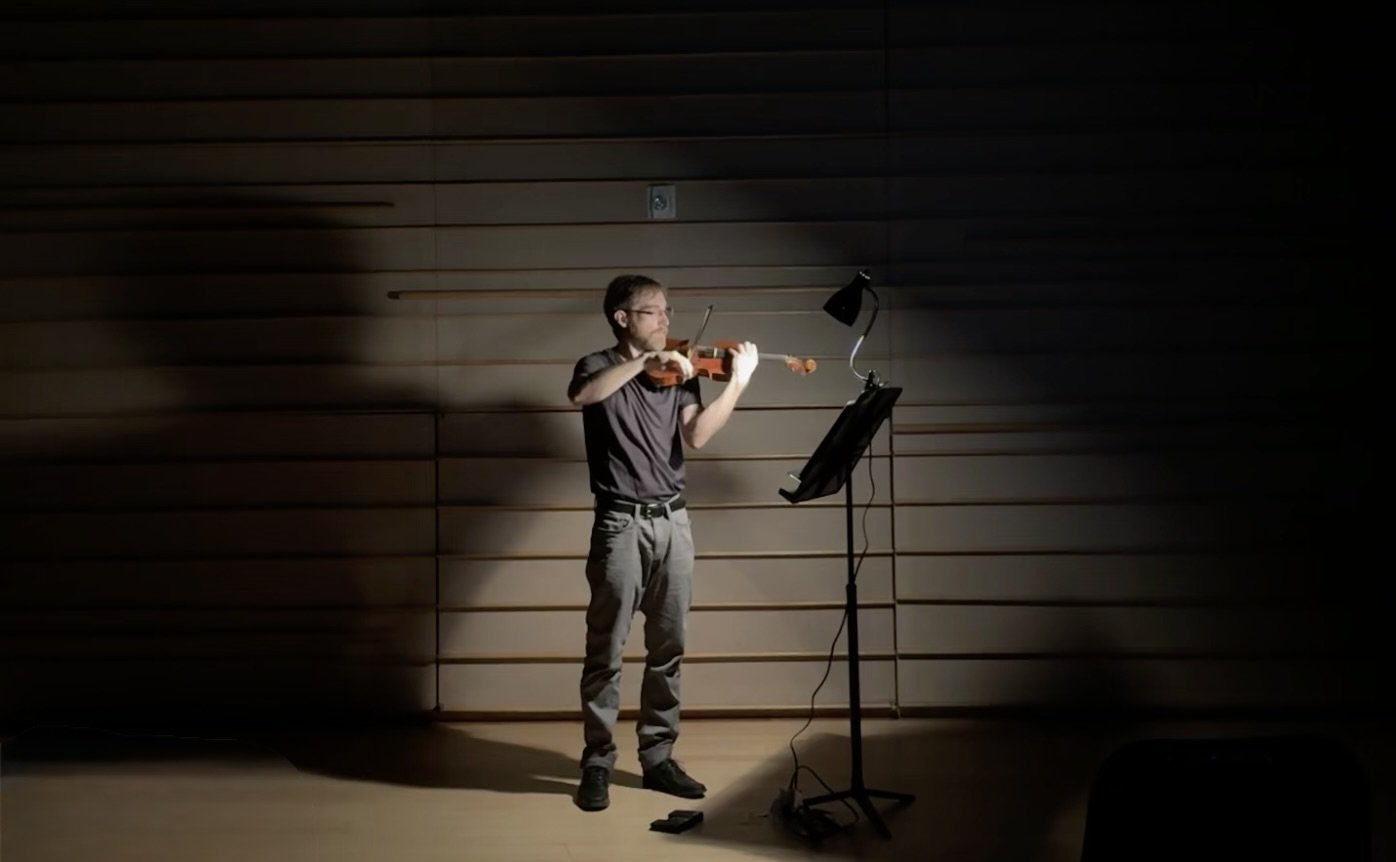
This music exists in the most spare and static territory of any of my work. At the same time, the simplicity of the material allows the entirety of the performer’s technique to come into focus in a form of hidden virtuosity.
Each piece lasts 40–45 minutes, and can also be performed individually under its own title. Ideally, the concert space remains completely dark except for a lamp clipped to the music stand, casting the player’s shadow.
The program was premiered on April 23, 2025 at The DiMenna Center for Classical Music, New York, NY.
About the pieces
Each half of the diptych reduces an aspect of music into a bare, elemental state: first melody, then harmony.
In Eden Melody (2023), the violin plays a gentle melody in a rocking rhythm. Subliminally, every note is tuned purely to the note that comes just before it, ignoring any of the concessions that allow systems of tuning to be self-consistent.
These accumulating perfections cause the pitch to drift further and further down the lowest string on the violin throughout the course of the piece, as the melody loses awareness of anything but the present moment.
In Time Escape Harmony (2024), the violin is retuned to be as resonant as possible by using only two different pitches, A and D. These are also the only pitches used within the music’s slow sequence of chords and silences.
The music progresses intuitively within this restricted, cyclic space, in which the shifting voicings and timbres become magnified out of proportion into their own world inside the harmonies.
Video/audio + revisions
Since the premiere, Eden Melody has been revised and slightly shortened (~40 min), and will have a more human, less objective playing style in future performances.
On the other hand, future performances of Time Escape Harmony will be even more expansive and still (~45 min).
The full concert video of the premiere is below. Higher quality audio (without video) is available here.
Bios
Samuel Clay Birmaher (rhymes with “here and there”) is a composer living and working in New York City. His music tells stories about internal and external worlds, using familiar musical elements to create undefined symbols.
Recent projects include a collaboration with Terry Riley on his open-ended work The Holy Liftoff for flutist Claire Chase, premiered by her with the JACK Quartet and featured in the 2025 Ojai Music Festival; Unity Song, a multi-hour composition accompanying an art installation by Tamiko Kawata at Alison Bradley Projects in NYC; and How to Become an Idea, a concert-length diptych of metaphysical solos for violinist Christopher Otto.
In 2026, the recording of The Holy Liftoff will be released on Sono Luminus, and Mode Records will release his first portrait album, Bleeding Heart Transformation, performed by guitarist David Nadal.
Christopher Otto’s work as a composer and violinist is driven by a desire to tune in to all the world’s vibrations. In bringing awareness to the interplay of tones, he invites each sound to contribute in its own way to a deeply resonant harmony.
Originally from Champaign, Illinois, Otto has lived in the New York City area since 2007. He studied composition at the Eastman School of Music and mathematics at the University of Rochester.
As a founding member of the JACK Quartet, he collaborates with many of today’s most adventurous composers, including Helmut Lachenmann, Catherine Lamb, John Zorn, Liza Lim, Tyshawn Sorey, and John Luther Adams. Performances around the world offer experiences that can be immersive, entertaining, and reflective.
Otto’s compositions have explored tuning systems extensively, playing with the boundaries of perception and highlighting the surprising sensations that emerge from specific combinations of frequencies. His piece rag´sma was recorded by JACK and released on greyfade. His violin octet, violin duo, and other works can be heard on Bandcamp and on his website, christopherotto.space.